Clear them, do not cap them
A UPVC board screwed over rotten timber hides the problem and feeds it. We take the old boards off and look at the rafter feet.
More damp gets blamed on roofs than roofs deserve. Very often it is a gutter that has not been cleared since 2019, and the cure costs less than the survey.
Gutters are the cheapest insurance on a house and the first thing everybody ignores. A blocked gutter overflows against the wall. The wall stays wet. The wet gets into the fascia behind it, the fascia rots, the rot reaches the rafter feet, and now a ninety-pound job is a four-figure job. That sequence is not hypothetical — it is most of what we find at the eaves on older Sutton and Boldmere properties.
Anywhere with mature trees is worse, and that is a lot of this patch. Properties backing onto Sutton Park, the tree-lined roads across the Four Oaks Estate, the older parts of Lichfield — those gutters need clearing every autumn, not every decade. We do it, we do it cheaply, and we would honestly rather you rang us for that than for the damp job it turns into.
On the boards themselves, the question is what is behind them. On a 1930s Wylde Green semi the original timber fascia has usually been painted over so many times that the rot is invisible until a ladder goes up. The quick trade answer is to cap it — screw a UPVC board straight over the rotten timber and let the customer admire the white plastic. That traps the rot, hides it, and lets it carry on into the rafter feet. We take the old boards off. If a rafter foot has gone soft we splice it. Then the new board goes on something solid.
We fit UPVC where it makes sense and we will fit and paint timber where the building calls for it — a Four Oaks Edwardian or a Lichfield period property with fat ornate timber bargeboards should not get a flat plastic board, and it is a mistake you cannot undo cheaply. We will tell you what we think and then do what you decide.
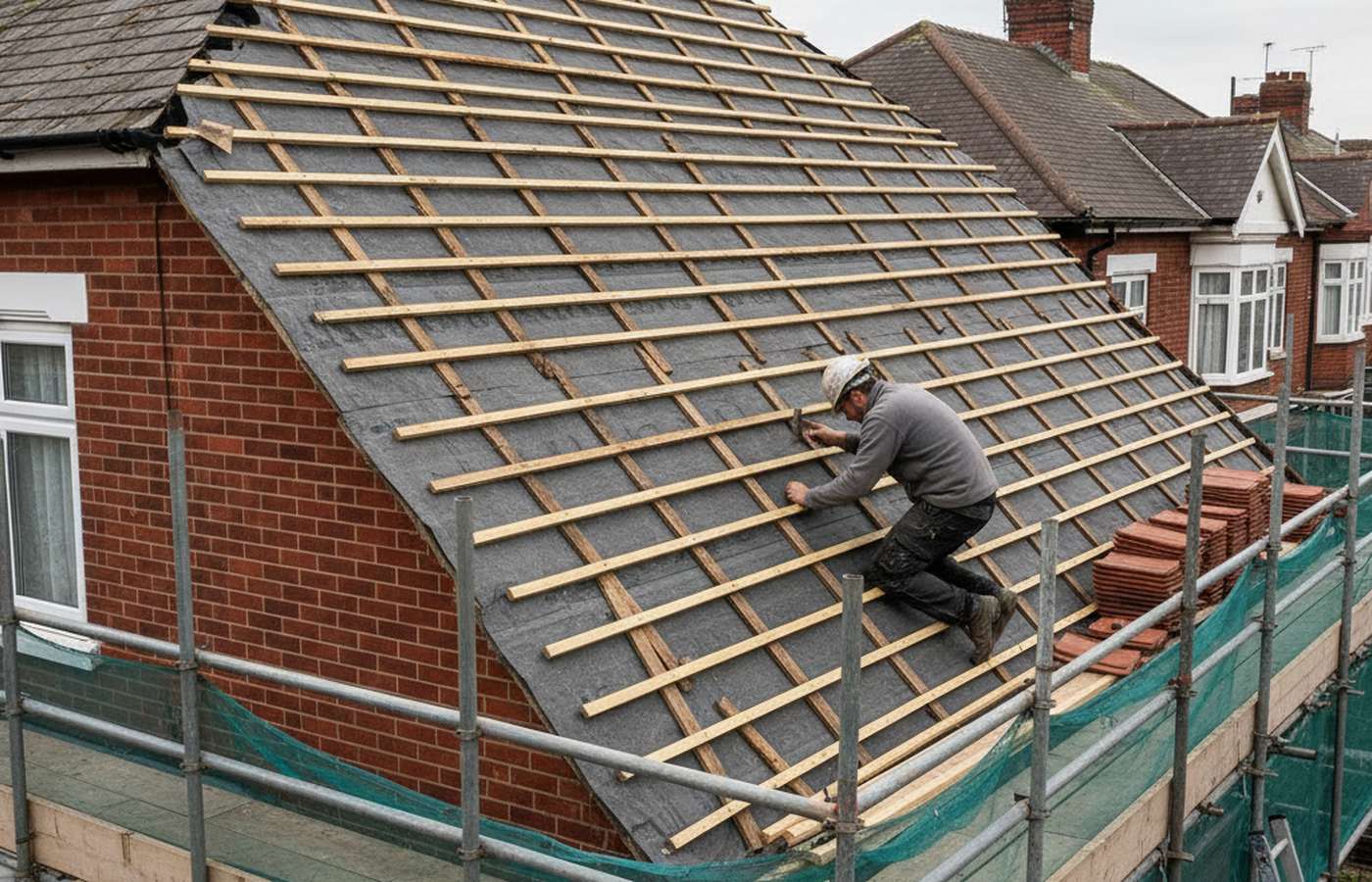
A UPVC board screwed over rotten timber hides the problem and feeds it. We take the old boards off and look at the rafter feet.
Gutter clearing is thin money and we still want the call, because it is the job that stops the expensive one.
Ornate bargeboards on a period property should not become flat plastic. On a 1970s estate house, UPVC is the sensible answer. Different buildings, different answers.
Backing onto Sutton Park or under the Four Oaks canopy? That is an annual job. We will tell you straight rather than sell you a one-off.
The questions we get most on this job. The full list is on our FAQ page.
Once a year for most houses. Twice if you are under mature trees — the Park edge, Four Oaks, the older Lichfield roads. Autumn is the one that matters.
We would rather not, and we will explain why on site. Capping traps rot against the rafter feet. It looks finished and it is storing up a much bigger bill.
UPVC on most post-war housing — it is sensible, it lasts, nobody paints it. Timber on period property with detailed bargeboards, where plastic would visibly flatten the building.
Sometimes, and honestly they are a mixed bag. Under heavy leaf fall they clog on top instead of inside, and then nobody looks because the guard is supposed to be handling it.
We have written these up properly, town by town, because the housing stock genuinely differs. Four Oaks is not Walmley.